


Introduction
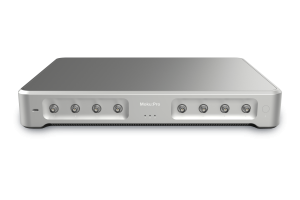
Researchers at Intel Labs’ photonic device research lab are working on a range of cutting-edge projects to advance and maximize the advantages of heterogeneously integrated silicon photonic integrated circuits (PICs). As team members typically explore new designs at a rapid pace in a highly experimental setting, they need reconfigurable, scalable tools with a small footprint to adapt to various situations. With multiple integrated Lock-in Amplifiers (Figure 1), Spectrum Analyzers, Frequency Response Analyzers, and PID Controllers on Moku:Pro, along with a best-in-class user experience, the team has achieved significant time savings and reduced complexity to advance progress and deliver results.
Figure 1: Moku:Pro Lock-in Amplifier iPad interface
The challenge
One specific challenge associated with PIC testing is to find the optimal bias condition for all the on-chip optical phase tuners, so the system functions as desired. Though this can be accomplished with multidimensional sweeps or optimization routines, script complexity and calculation time quickly become significant as more phase tuners are involved. Controlling the tuners with analog, single-function benchtop instruments (e.g., conventional lock-in amplifiers, PID controllers, etc.) may avoid the problems, but cabling and footprint make this approach cumbersome when dealing with large tuner counts. Moreover, the lack of a modern user interface in these conventional instruments makes knowledge transfer to new researchers difficult when working on photonic IC control.The solution
With the advanced functionality, instrument specifications, and reconfigurability offered by Moku:Pro, Intel Labs researchers can utilize two Lock-in Amplifiers and two PID Controllers simultaneously in Multi-Instrument Mode (Figure 2). This flexibility significantly minimizes their overall equipment footprint and reduces the necessary cabling. Since Moku:Pro provides an analog output range of 10 Vpp, the team no longer needs external amplification for experiments involving high voltages. The high-precision front end ensures excellent signal clarity with high resolution. The researchers also appreciate the device’s intuitive graphical user interface, which is easy to understand, simple to use, and offers convenient block diagrams to reinforce system-level understanding across the experiment. Having the ability to save and load Multi-Instrument Mode configurations between experiments has optimized timelines and enabled efficient knowledge transfer among team members. Looking forward, the team can further streamline testing by utilizing Moku Cloud Compile to prototype control algorithms before deploying. This will enable them to prototype control algorithms and deploy them to the Moku:Pro FPGA for real-time, closed-loop system-level characterization.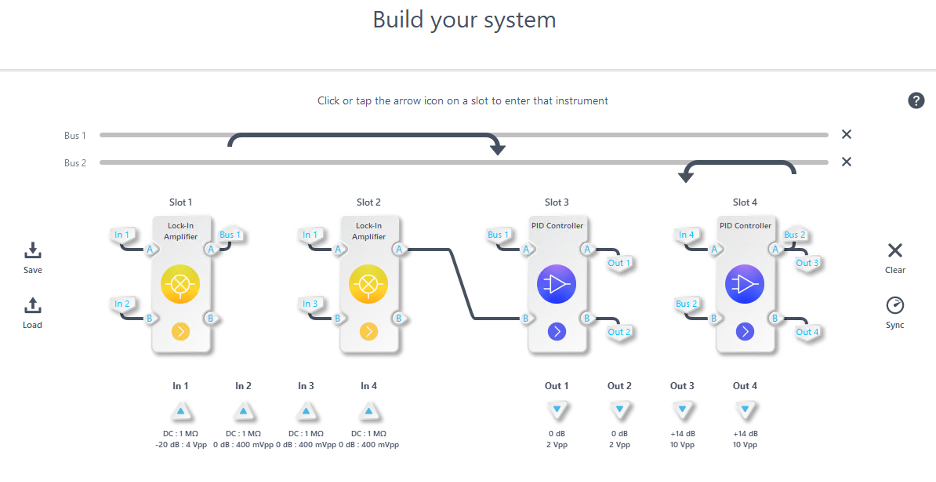
Figure 2: Configuring multiple Moku:Pro Lock-in Amplifiers and PID Controllers in Multi-Instrument Mode