

Please update your browser. For the best Liquid Instruments experience, update to the latest version of Chrome, Edge, Firefox, or Safari. Update Microsoft Edge.
Liquid Instruments Logo
Products
Hardware Platforms
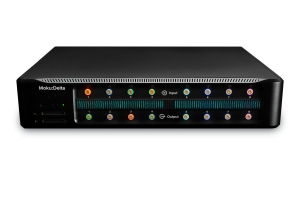
Moku:Delta
Moku:Delta
New
For advanced design and validation
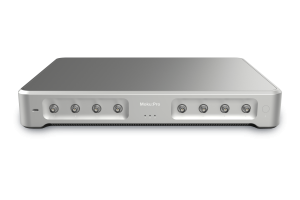
Moku:Pro
Moku:ProFor versatile test and measurement
Moku:Lab
Moku:LabFor experimental research labs
Moku:Go
Moku:GoFor quick testing and debugging
Compare Hardware
Compare HardwareView a side-by-side of all Moku hardware
Technologies
GenInst Studio
New
Generate personalized instruments
Integrated InstrumentsProfessional-grade instruments at your fingertips
Neural NetworkFPGA-powered neural network integration
Multi-Instrument ModeCombine instruments to create a customized test system
Moku CompileCode, compile, and deploy to your Moku's FPGA
Software
MokuOSDownload the Moku app for Windows, macOS, iPadOS & visionOS
APIsPython, MATLAB, LabVIEW
UtilitiesCommand line and graphical tools for file conversion
Instruments
Analysis
Oscilloscope
Spectrum Analyzer
Frequency Response Analyzer
Lock-in Amplifier
Phasemeter
Logic Analyzer / Pattern Generator
Time & Frequency Analyzer
Data Logger
Generation
Waveform Generator
Arbitrary Waveform Generator
Control & Conditioning
PID Controller
Digital Filter Box
FIR Filter Builder
Laser Lock Box
Custom & Utility
GenInst Studio
New
Gigabit Streamer
Custom Instrument
Neural Network
Multi-Instrument Mode
Applications
Optics and Photonics
Microscopy and Spectroscopy
Photon Counting
Quantum Optics
Aerospace and defense
A&D Instrumentation
Component Test
Automated Testing
Semiconductor Test
Control Systems and Bode Analysis
MEMS Testing
AI and Machine Learning
Generative Instrumentation
New
Neural Networks
Education
Education and Research
Resources
App Notes
Blog
Case Studies
Coursework
Guides
Product Documentation
Publications
Webinars
White Papers
Support
Company
Contact Us
About Us
Leadership
Partners
News & Updates
Press
Events Calendar
Careers
Store
Moku:Delta
Moku:Pro
Moku:Go
Upgrade Moku:Pro
Upgrade Moku:Lab
Upgrade Moku:Go
0
Get a quote Buy Now
Case studies

Phase stabilization using the Moku:Pro PID Controller at the University of Münster

Using Multi-Instrument Mode to accelerate phase stabilization of highly sensitive, fiber-based systems

March 9, 2023

    Introduction

    The University of Münster is Germany’s fifth-largest university, offering more than 120 diverse fields of study. The University of Münster (WWU) Optical Technologies group, part of the Institute of Applied Physics, conducts research in a variety of fields including nonlinear optics and laser concepts. Ph.D. student Kristin Wallmeier, who specializes in nonlinear microscopy, is working to improve phase stabilization of a two-output pulse train. Kristin’s setup includes a fiber-based oscillator and a subsequent fiber-based optical parametric oscillator. Her goal is to synchronize the fiber-based oscillator, providing the pump of the fiber-based optical parametric oscillator with the output of the fiber-based optical parametric oscillator.

    Since her research is highly experimental, she needs a variety of test equipment on any given day for exploratory testing. By using embedded instruments available through Moku:Pro, including the Digital Filter Box and PID Controller in Multi-Instrument Mode seen in Figure 1, she is enhancing the phase stabilization of the setup.
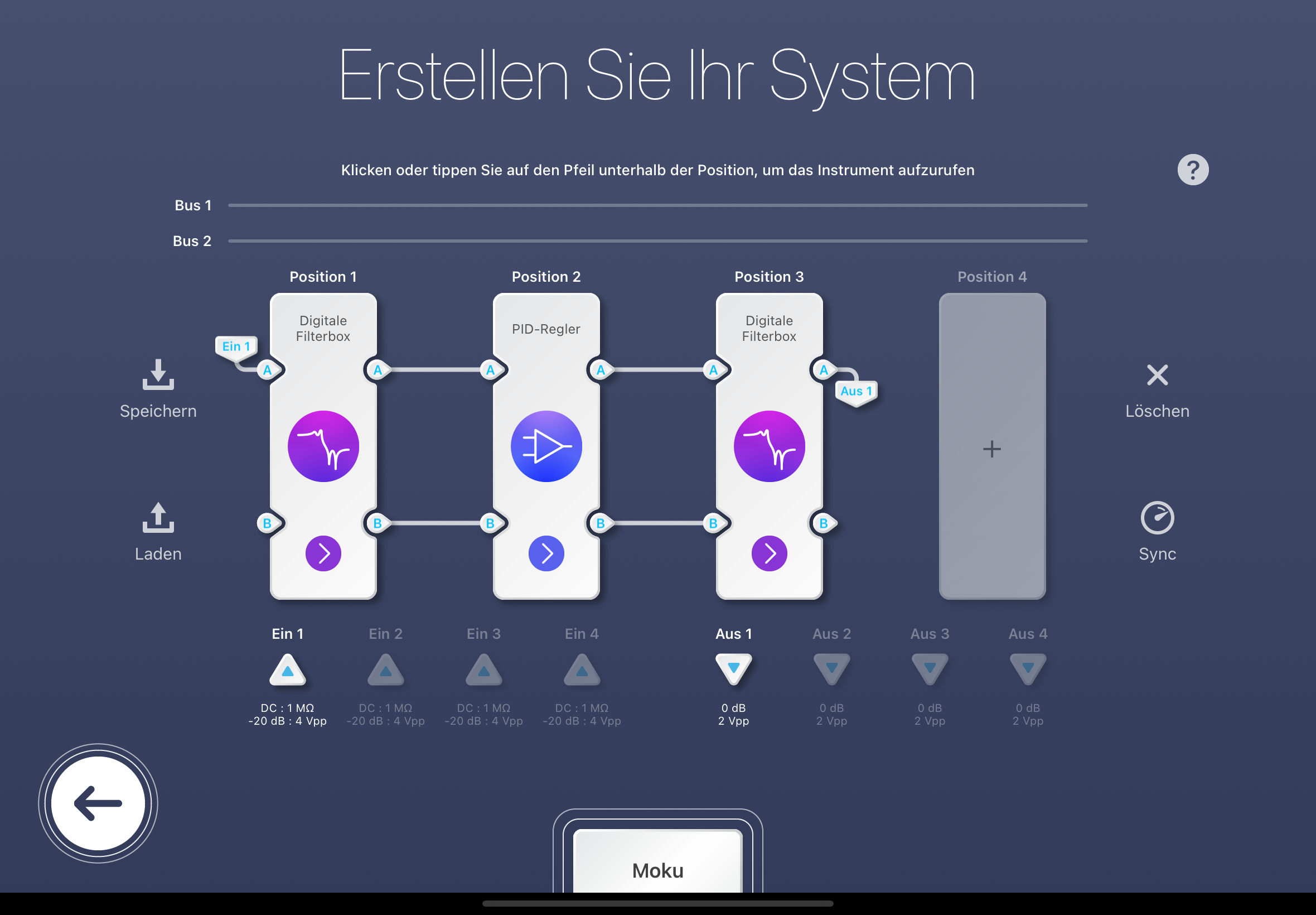
     

    Multi-instrument Mode on Moku:Pro: Digital Filter Box, PID Controller, and another Digital Filter Box

    Figure 1: Multi-Instrument Mode setup with two Digital Filter Boxes and a PID Controller for phase stabilization

    Moku:Pro offers up to 15 software-defined instruments, ranging from common bench necessities to unique, essential instruments to streamline even the most experimental lab setups. Using Moku:Pro, Kristin has accelerated her research with a compact solution and flexible test configuration options, as well as an intuitive, iPad-based user interface.

    The challenge

    Fiber-based systems are highly sensitive to environmental fluctuations such as mechanical vibration and thermal fluctuations. Phase stabilization requires an incredibly stable, fast feedback circuit to correct any changes in the system. The system must be fast enough to restabilize after a disturbance takes place. The system can also be sensitive to noise, so filtering is necessary to achieve clean input and output signals. Without digital filtering options, Kristin would have needed to build analog filters with RC components to ensure she filters out signals that may interfere with the resonant frequency of the piezoelectric actuator that is used to adjust the phase within the feedback circuit.

    Before selecting Moku:Pro, Kristin started with an Arduino development board that required her to manually code and develop the features she needed for her research. She quickly determined that the Arduino performance was insufficient when she realized it was too slow to stabilize the feedback loop in her setup. Moku:Pro was a much more efficient solution for her research thanks to its speed enhancements and full suite of preprogrammed, software-defined instrumentation.

    The solution

    Using the Moku:Pro PID Controller and Digital Filter Box in Multi-Instrument Mode (MiM) through the iPad interface, Kristin can accelerate her research and focus more on improving the phase stabilization of the system rather than spending time developing complex test procedures. Kristin first applied digital filters to the input signal to filter out high-frequency components. After using the PID Controller, she further improves signal quality with another Digital Filter Box to remove all high-frequency components that are in the range of the resonant frequency.

    “The Digital Filter Box is quite nice because I can just try a lot of different setups without buying all of them and building them in an analog way,” she said.

    The easy-to-use PID Controller was Kristin’s main motivation for integrating Moku:Pro into her experiment. When a disturbance occurs, the PID Controller quickly reacts and restabilizes the system, as seen in Figure 2. With the ability to probe multiple points in the signal path, Kristin and her team can use the embedded Oscilloscope to watch the system restabilize the input signal in real time. 
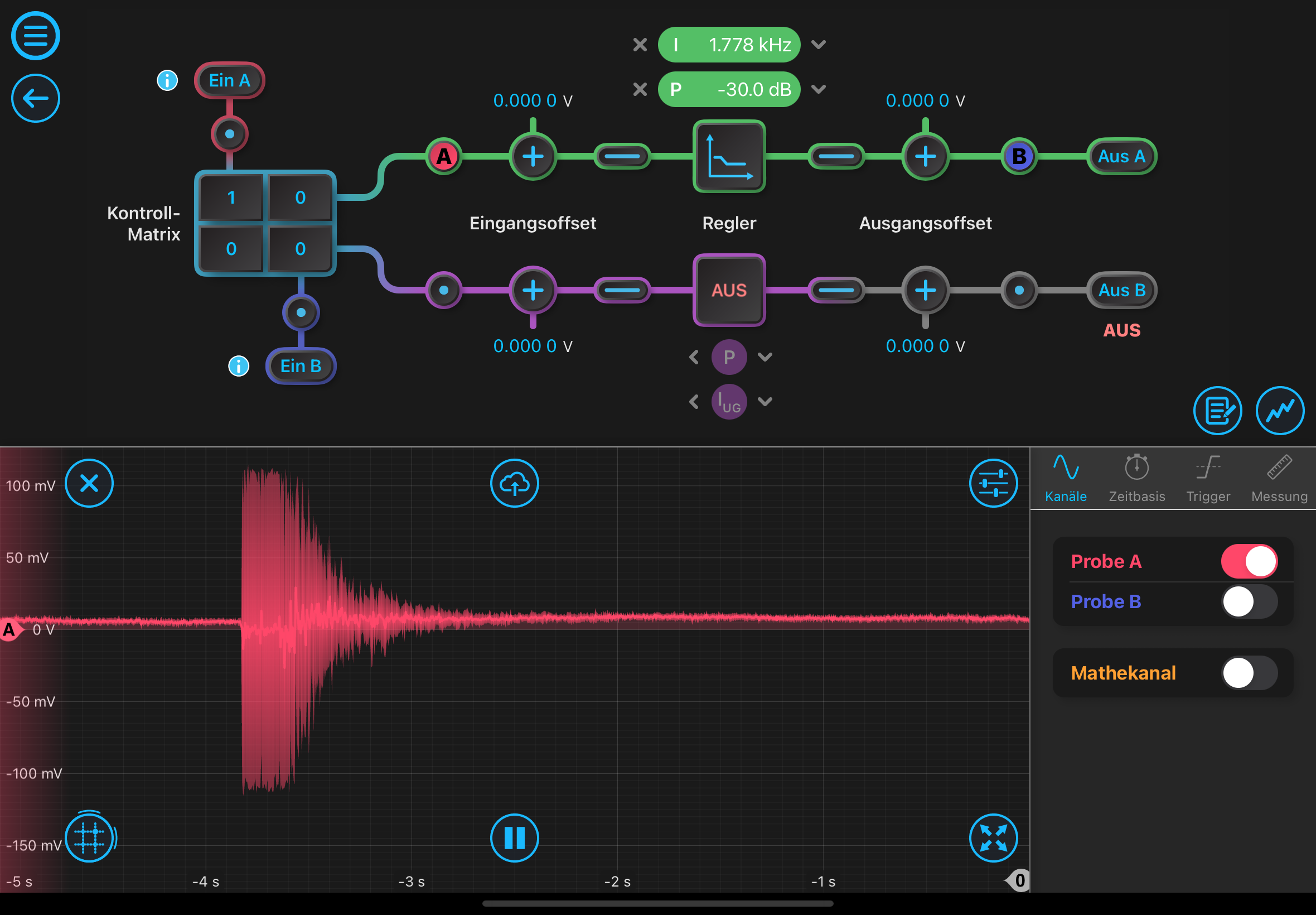
    Phase stabilization oscilloscope view in the Moku:Pro PID Controller

    Figure 2: Setup of the PID Controller (top) and input signal for the PID Controller (bottom), showing a disturbance of the stabilized phase and the reaction of the system to restabilize

    The result

    Kristin continues to advance her research by meticulously monitoring her experiment and working to improve the stability of the system. By using the Moku:Pro Digital Filter Box and PID Controller, Kristin has maximized time and cost savings by eliminating the need for do-it-yourself solutions such as building filters with RC components. 

    “It’s quite intuitive to set up everything and work with it,” Kristin said. 

    Using Moku:Pro has also reduced the need for additional instrumentation. Because of the future-proof nature of the device, she and her team can simply update the software as needed to use new features or instrumentation after they are released. 

    “It’s the best, so it doesn’t really make sense to buy another instrument, then another one, and another one,” she added.

    Kristin plans to use Moku:Pro for other research in the future, such as stimulated Raman scattering (SRS) microscopy projects utilizing the Lock-in Amplifier, another instrument available through Moku:Pro. 

    To learn more about Moku:Pro, contact us at info@liquidinstruments.com.

    Try Moku in demo mode Download the Moku app → Get answers to FAQs Visit Knowledge Base → Connect with Moku users Join the user forum →

    Other Recommended Case studies

    Case studies
    Phase Stabilization for Quantum Key Distribution with Moku:Pro

    Learn how researchers at the University of Hamburg are using Moku to improve signal fidelity for continuous-variable QKD.

    Featuring: Moku:Pro, PID Controller, Lock-in Amplifier, Laser Lock Box

    Date: Mar 16, 2026

    Case studies
    Enabling Dual-Wavelength Nanosecond Fiber Lasers for Multi-Contrast Photoacoustic Imaging with Moku:Pro

    Learn how researchers at the University of Hong Kong used Moku:Pro to generate synchronized shortwave-infrared nanosecond pulses and stabilize modulation depth for dual-wavelength photoacoustic imaging.

    Featuring: Moku:Pro, Waveform Generator, PID Controller

    Date: Dec-19-2025

    Case studies
    Teaching lock-in detection with Moku:Go

    Learn how students at IIT Madras are gaining hands-on experience in using the Lock-in Amplifier instrument on Moku:Go

    Featuring: Moku:Go, Lock-in Amplifier

    Date: Dec-15-2025

    Back to all Case studies

    Nav

    • Products
    • Instruments
    • Resources
    • Support
    • Company
    • Contact Us
    • Privacy Policy
    • Terms of Use

    Offices

    United States
    (619) 332-6230
    12526 High Bluff Dr.
    Suite 150
    San Diego, CA 92130

    Australia
    +61 2 6171 9730
    243 Northbourne Avenue
    Suite 1, Level 1
    Lyneham, ACT 2602

    Australia
    +61 3 7073 3594
    Suite 5C, Level 5,
    700 Swanston Street,
    Carlton, VIC – 3058


    Follow us

    LinkedIn YouTube X Facebook Instagram

    官方微信

    © 2026 Liquid Instruments. All rights reserved.