


Introduction
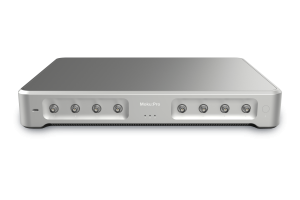
At the University of Münster, a top educational institution in Germany that offers degree programs in more than 120 fields, Ph.D. student Michael Zwilich is working hard to characterize beams with different spatial profiles. Instead of suppressing the higher-order transverse modes, much like in typical gravitational wave detection methods with a single-frequency Gaussian beam, Michael — who specializes in different transverse modes in solid-state lasers — is deliberately generating these transverse modes. To do so, he’s using the Moku:Pro Laser Lock Box and the Pound-Drever-Hall (PDH) locking technique, seen in Figure 1. While scanning the resonator length, each transverse mode (HG) that resonates within the resonator generates an error signal, seen in Figure 1. Users can then select a resonance by using the Lock Assist feature and tapping a zero-crossing point. At this point, the resonator length is locked to the laser frequency so that the desired transverse mode is constantly transmitted. Moku:Pro offers up to 15 software-defined instruments, ranging from common bench necessities to unique, essential instruments to streamline even the most experimental lab setups. Moku:Pro provides Michael with a compact solution, which has accelerated his research with versatile test configuration options and an intuitive, iPad-based user interface.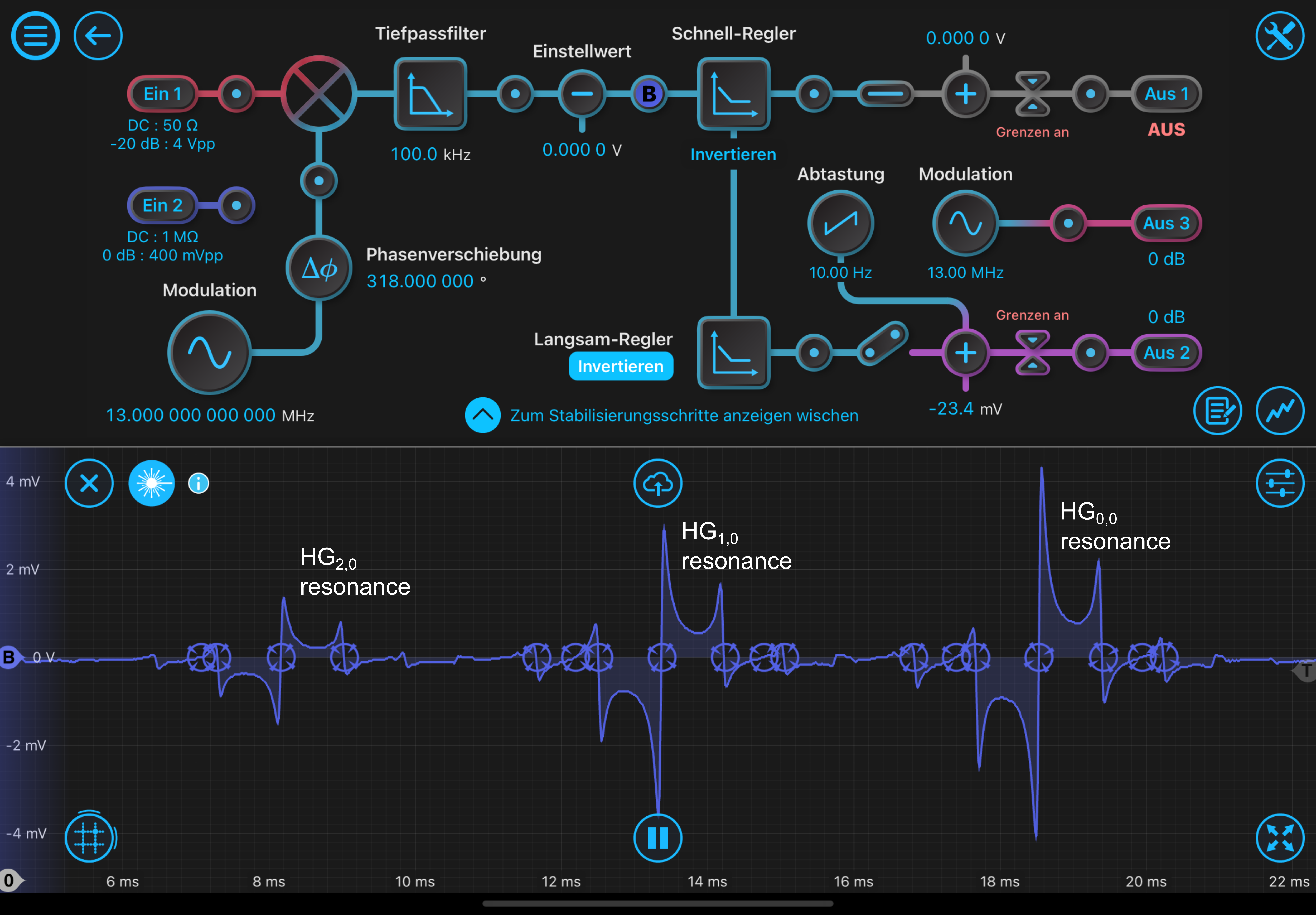
Figure 1: Screenshot of the Laser Lock Box interface showing the embedded Oscilloscope view of the error signal traces typical for Pound-Drever-Hall locking
The challenge
Before adopting Moku:Pro, Michael and his team would have to constantly excite a particular recurring resonance state with their previous experimental setup. They would ramp the resonator length to eventually establish resonance of a certain transverse mode within the resonator. However, without the Laser Lock Box, the state Michael is interested in is only temporarily present at certain points in time, so he had limited opportunities to detect and characterize the signal. Additionally, Michael had to frequently repeat these steps to advance his research. Since this process was time-consuming and repetitive, the team sought out instrumentation to solve this problem by enabling faster, more streamlined measurements.The solution
Using the Moku:Pro Laser Lock Box, Michael and his team can lock the resonator length to the laser frequency and thereby compensate for the mechanical vibrations and thermal fluctuations in the setup, maintaining the resonant state for indefinite periods of time. “Now that the state is locked, I can just look whenever I want to,” he said. “This makes life so much easier.” With Moku:Pro, Michael is no longer constrained by limited time periods, during which he can characterize the signal. Figure 2 shows images of the resulting transverse modes that he generated with the help of the Laser Lock Box. By actively controlling the resonator length, Michael can force oscillation in a selected transverse mode, such that this output mode is continuously emitted from the resonator.
Figure 2: Images of the resulting modes
Since Michael is in the early prototyping phase of his research, using Moku:Pro allows him to quickly experiment with various instruments. “Moku:Pro enables me to just try it out without having to buy dedicated electronics,” Michael said. “Its versatility allowed me to just try whether this works at all.” By using a device that offers both standard test equipment and complex instruments like the Laser Lock Box, Michael has necessary instruments available before he knows he needs them. He can further his research without knowing specific requirements for instrumentation, especially at the early research stage. For monitoring and analysis, he also used the Moku:Pro Oscilloscope, Waveform Generator, and Frequency Response Analyzer — all without purchasing additional pieces of costly test equipment in his space-constrained lab. Using a Liquid Instruments application note on laser locking, Michael set up the laser locking system easily. “Prior to that, it was just tedious,” said Michael. Using the application note and Laser Lock Box, Michael streamlined the setup to better focus on his research goals rather than fussing over technical measurement details. Since he is no longer limited by the constraints of the setup and test equipment, Michael is making progress much faster. Although he typically uses the desktop interface to control Moku:Pro, he likes having the iPad because it offers an extra screen and it’s easy to move around the lab. “You can spread out the information without having to be confined by one monitor,” said Michael of the iPad interface.The result
By utilizing the Moku:Pro Laser Lock Box, Michael and his team have accelerated their research during the early prototyping stage. He plans to continue his experiment by further optimizing the setup and using Moku:Pro to continuously monitor signals. The versatility of Moku:Pro allowed Michael to focus on his research rather than making his setup work for the test equipment. “In research, there are often situations where you can’t really say exactly what you need before you start, so having a tool that allows you to jump right in and try it out, then see what specific things you need, makes things much more comfortable,” Michael said. Instead of hitting roadblocks when needing new, specialized equipment, with Moku:Pro, the tools he needed to expand testing were already there. To learn more about Moku:Pro, contact us at info@liquidinstruments.com.